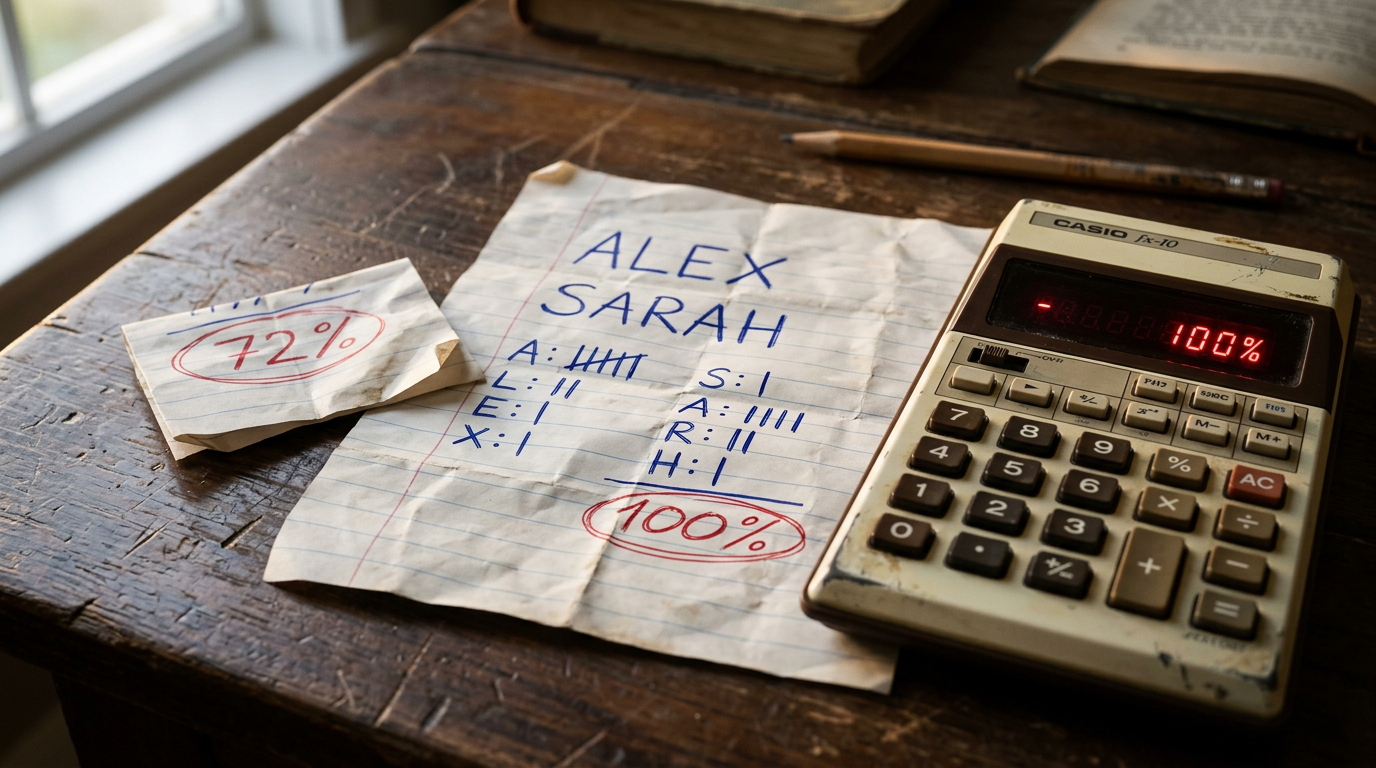
Most people who search "can you get 100% on a love calculator" aren't really asking about the math. They're asking something harder: Is any of this real? The 100% question is a proxy for a deeper one — does this number mean anything at all?
Here's the honest answer: yes, you can get 100%. And the fact that you can is precisely what makes it meaningless.
Yes, You Can Get 100% — Here's Why That's Not the Flex You Think It Is
Getting a perfect score on a name-based love calculator is less like acing a compatibility test and more like winning a slot machine you didn't know was rigged. The algorithm didn't evaluate your communication styles, your attachment patterns, or whether you both want kids. It looked at the letters in two names and ran them through a formula.
What does 100% on a love calculator actually mean? On most platforms, it means the algorithm produced a perfect name-based match — nothing more. The names "Tom" and "Emma" might score 94% while "Thomas" and "Emily" score 61%. Same two people. Different inputs. Completely different result.
This isn't a bug. It's the entire architecture of the system.
The tools that generate these scores are built on letter-counting heuristics, character-sum arithmetic, or proprietary hash functions that reduce two names to a single integer. The ceiling is 100 because that's a satisfying number. It implies completeness. It implies you've found the one. But the ceiling being reachable — and easily reachable — exposes the whole thing.
How Most Love Calculators Actually Generate Their Score
The most common method behind digital love calculators involves summing the numerical values of characters in both names, applying some modular arithmetic, and mapping the result to a 0–100 scale. Some use ASCII values. Some use letter position in the alphabet (A=1, B=2, etc.). Some combine first and last names; others use only first names.
The result is deterministic — the same two names will always produce the same score on the same calculator. But change the calculator, and you'll get a different number. That inconsistency alone tells you everything about what these scores measure.
A few platforms add a layer of randomness, which is arguably more honest. At least random output doesn't pretend to be calculated.
The love calculator percentage meaning, in most cases, is simply: this is where your name combination landed on our arbitrary scale. The number feels significant because percentages carry psychological weight. We're trained to interpret 85% as "good" and 40% as "concerning." Calculators exploit that conditioning.
The Paper Love Calculator Method: How It Works Step by Step
Before apps, there was the classroom version — a ritual most people encountered somewhere between fifth grade and a slow Tuesday in middle school. The paper love calculator method has two main variants, and both are worth understanding, partly because they're genuinely fun, and partly because seeing the mechanics laid bare makes the arbitrariness impossible to ignore.
The Letter-Counting Method Explained
This is the original. Here's how it works:
- Write both names side by side: JAMES SARAH
- Count how many times each letter in the word LOVE appears across both names combined.
- L: count all L's
- O: count all O's
- V: count all V's
- E: count all E's
- Write those four counts in a row. Example: 2 1 0 3
- Add adjacent numbers repeatedly until you're left with two digits.
- 2+1=3, 1+0=1, 0+3=3 → 3 1 3
- 3+1=4, 1+3=4 → 4 4
- That's your score: 44%
- Repeat with the names reversed to get a second score (his feelings vs. her feelings, supposedly).
The paper love calculator uses a name letter counting method — that's the entire engine. No psychology. No birth dates. No planetary positions. Just letter frequency applied to a word that happens to be LOVE.
The score is completely dependent on which names you use. Nicknames versus full names will produce wildly different results. "Mike" and "Mike" will give you a different score than "Michael" and "Michael."
The FLAMES Variant of the Paper Method
FLAMES is a separate game but often gets bundled into the love calculator category. The acronym stands for Friends, Lovers, Affectionate, Marriage, Enemies, Siblings — the six possible relationship outcomes.
The method:
- Write both names.
- Cross out all shared letters (matching pairs, one from each name).
- Count the remaining uncrossed letters.
- Use that count to eliminate letters from FLAMES by counting around the circle repeatedly until one remains.
The outcome — whether you land on L for Lovers or E for Enemies — depends entirely on how many letters the names share. It's a counting game dressed up as prophecy.
Knowing this doesn't make it less fun to play. But it does make it impossible to take the result seriously.
Calculator Number Tricks: How to Get Any Score You Want
Once you understand that most love calculators run on name arithmetic, gaming the system becomes trivial. These are the number tricks people actually use:
Vary the name format. "Alex" versus "Alexander" versus "Alex Johnson" — each produces a different hash value. Run all three and pick your favorite result.
Add or drop middle names. Middle names are wild cards. Inserting one changes the character count and, with it, the output. Some calculators accept full legal names; others cap at a single word. Experiment with both.
Try nicknames and alternate spellings. "Catherine" versus "Katherine" versus "Kate" can move a score by 20+ points on the same calculator. Same person, completely different number.
Write 'I love you' as a name. Some calculators accept phrases rather than just names. Entering "I love you" as one field and a name as the other sometimes produces inflated scores because the phrase contains high-frequency letters that interact favorably with common name characters.
Use multiple calculators and report the best one. This is the most common trick, and it's so obvious it barely qualifies as a trick. Different platforms use different algorithms. Running the same names through five calculators and averaging them — or just sharing the highest — is standard operating procedure for anyone who's tried to impress someone with a love score.
The point isn't that people are being deceptive. The point is that the score is malleable enough to be whatever you want it to be. That's the tell.
What a Score Actually Means When Astrology Is Involved
Not every compatibility score is name-based arithmetic. Some calculators — and the better ones — factor in birth dates, zodiac signs, and planetary placements. That's a fundamentally different category of tool.
Astrological compatibility analysis looks at things like elemental alignment (fire with air, earth with water), the relationship between your sun signs, and the more granular picture that emerges when you compare moon signs, Venus placements, and Mars energy. A Scorpio sun paired with a Taurus sun has a specific, documented tension — fixed signs in opposition, with real implications for how those two people handle power and change.
When a calculator built on that framework produces a score of 72%, that number carries information. It might reflect strong elemental compatibility offset by a challenging Mars square. It might indicate that your sun signs harmonize but your Venus placements create friction in how you each express affection. The score is a compression of actual variables.
For a deeper look at what what your sun sign pairing says about your compatibility — and where the standard zodiac analysis falls short — the picture gets more nuanced than any single percentage can capture.
If you want to try a love calculator where the score actually means something, the difference is immediately apparent: the inputs are birth dates, not names, and the output comes with an explanation of what's driving the number.
The Score That Should Worry You (and the One That Should Reassure You)
Here's the counterintuitive part: a 100% from a name-based calculator should make you suspicious, not euphoric. It means the algorithm liked your letter combination. That's all.
A 72% from an astrologically grounded analysis is a different thing entirely. It might mean you share strong elemental compatibility and complementary Venus placements, but your Mars signs create friction around conflict resolution. That friction is real — and knowing about it is useful. You can work with a 72% that comes with a map. You can't do anything with a 100% that comes from nowhere.
The scores that should actually concern you are the ones with no methodology behind them — the ones where you can change your name slightly and watch the number jump 30 points. That volatility is proof the score measures nothing stable.
Numerology-based approaches, like life path number compatibility, occupy a middle ground. They use birth dates rather than names, which makes them more stable and less gameable, even if the interpretive framework is different from Western astrology.
And for anyone who's wondered whether their relationship has a longer arc — whether it's a twin flame dynamic or something more grounded — the distinction between twin flames and soulmates matters more than any single compatibility score.
The history of love calculators, from playground paper games to algorithmic tools, is worth understanding too. The origin of the love calculator traces back to a 1996 website called Doctor Love — and knowing that context makes the 100% question land differently. These tools were built for entertainment. The good ones evolved into something more. Most didn't.
So: can you get 100%? Yes, easily, and on purpose if you want to. The better question is whether the number you're looking at was built to tell you something true — or just something satisfying.