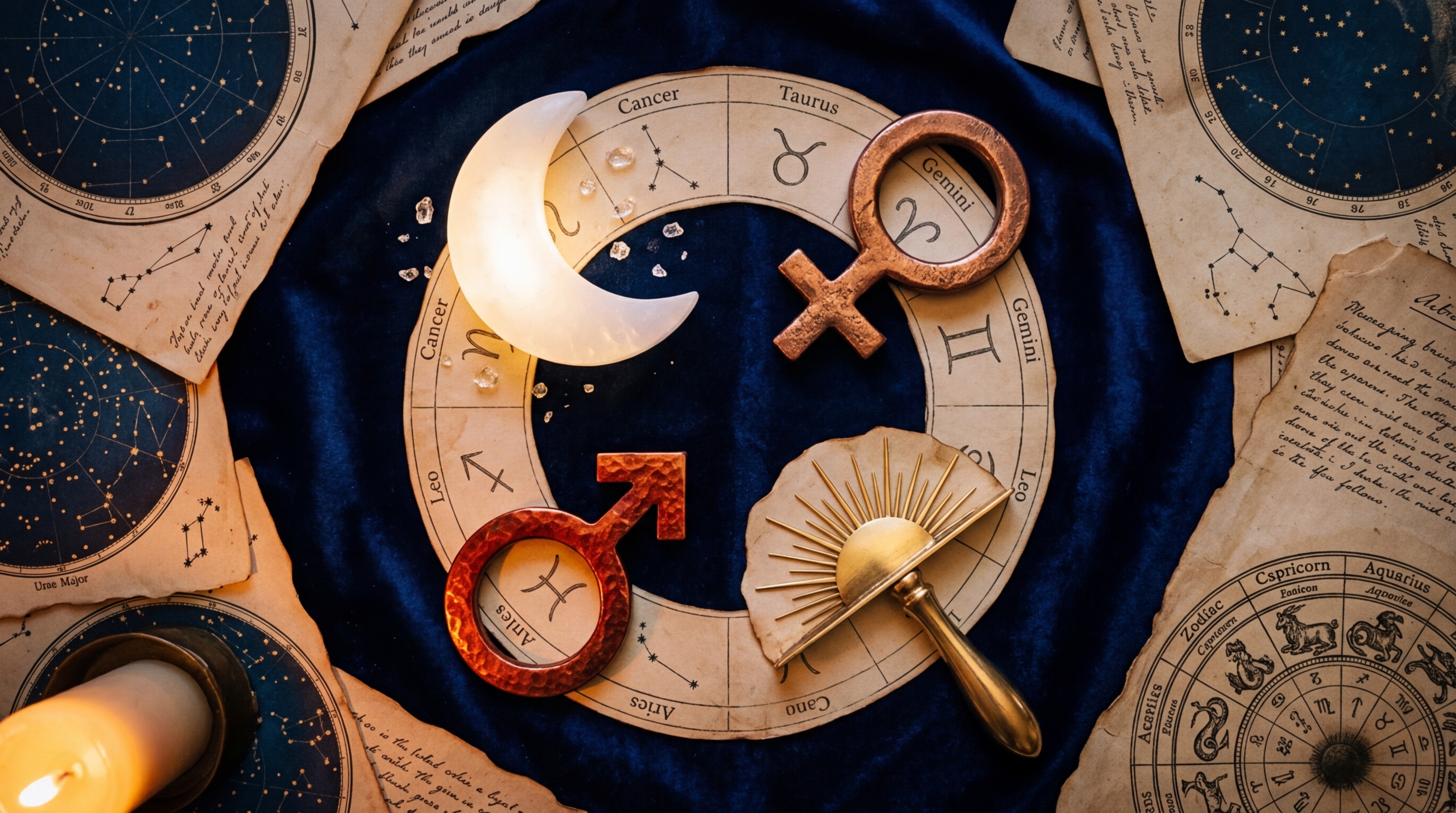
Most people discover astrology through their sun sign — Scorpio, Gemini, Capricorn — and then use it to judge every romantic prospect they meet. They Google "Aries and Cancer compatibility," read three paragraphs of generalized advice, and decide the relationship is doomed. What they've done is the astrological equivalent of evaluating a car by its paint color and ignoring the engine, transmission, suspension, and fuel system entirely.
The sun sign describes your core identity — the ego, the will, the broad strokes of personality. But relationships don't operate at that level. They operate in the emotional trenches, in desire, in the way two people's nervous systems respond to each other at 11pm after a difficult conversation. For that, you need four other placements: moon, Venus, Mars, and rising. Each one governs a distinct dimension of how you love and how you're loved.
Why Sun Sign Alone Misses Most of the Story
Here's the problem with sun sign compatibility: it's a one-dimensional filter applied to a multi-dimensional phenomenon. Two people can share the same sun sign and be romantically incompatible at every other level. Two people with "incompatible" sun signs can have moon signs, Venus placements, and Mars energies that interlock almost perfectly.
The sun changes signs roughly every 30 days. But the moon changes signs every 2.5 days. Venus takes about 19 months to cycle through all 12 signs. Mars takes about two years. Your rising sign depends on the exact time and location of your birth. This means that two people born the same week, in the same city, with the same sun sign can have completely different emotional needs, attraction styles, and conflict patterns.
Generic horoscope compatibility — the kind in magazines and most apps — ignores all of this. For a more grounded take on how your sun sign fits into the bigger compatibility picture, it helps to understand what sun sign analysis can and cannot tell you. The short answer: it's a starting point, not a verdict.
Moon Sign: The Emotional Compatibility Layer
If the sun is who you are, the moon is how you feel — and more importantly, how you need to be made to feel safe.
Your moon sign is calculated from the moon's position at the exact moment of your birth. It rules emotional responses, attachment style, what makes you feel nurtured, and what triggers your deepest insecurities. In a long-term relationship, moon sign compatibility often matters more than sun sign compatibility. You can admire someone's sun sign personality from a distance. You have to live inside their moon sign every single day.
What Moon Sign Governs in a Relationship
The moon governs:
- Emotional needs: A Scorpio moon needs depth, intensity, and unwavering loyalty. A Gemini moon needs conversation, intellectual stimulation, and the freedom to feel multiple things at once.
- Attachment and comfort: Cancer moon wants to nurture and be nurtured. Aquarius moon needs emotional autonomy even within intimacy.
- Reactivity and moods: Aries moon processes feelings quickly and moves on. Taurus moon takes time to shift emotional states — they need stability, not speed.
- What "home" feels like: Literally and figuratively. Moon sign shapes what environment feels safe and what kind of partner makes you feel at home.
When moon signs clash — say, a Scorpio moon paired with an Aquarius moon — you get two people with fundamentally different emotional languages. Scorpio moon experiences Aquarius moon's detachment as abandonment. Aquarius moon experiences Scorpio moon's intensity as suffocation. Neither person is wrong. They're just operating on different emotional frequencies.
Moon Sign Combinations That Create Emotional Safety
The most harmonious moon sign pairings tend to share the same element or complementary ones:
- Water + Water (Cancer, Scorpio, Pisces): Deep emotional resonance. Risk: co-dependency or emotional spiraling.
- Earth + Earth (Taurus, Virgo, Capricorn): Stability, practicality, shared need for security. Risk: emotional avoidance.
- Fire + Fire (Aries, Leo, Sagittarius): Passionate, energetic, adventurous emotional life. Risk: competing for emotional space.
- Air + Air (Gemini, Libra, Aquarius): Intellectually stimulating, good communication, mutual need for freedom. Risk: emotional shallowness.
- Earth + Water: Often a very supportive pairing — earth provides structure, water provides emotional depth.
- Fire + Air: Lots of excitement and mental stimulation, though emotional depth can be harder to reach.
Cross-element pairings aren't doomed — they just require more conscious translation. A Pisces moon and a Virgo moon (opposite signs) can create a powerful balance if both people understand what the other needs.
Venus Sign: How You Attract and What You Find Attractive
Venus sign determines romantic attraction style — not just who you're attracted to, but how you express affection, what you value in a partner, and what love actually looks like to you in practice.
This is where a lot of compatibility analysis goes wrong. People assume attraction is purely about chemistry, which is somewhat true. But Venus shapes the type of chemistry you respond to. A Venus in Capricorn person is attracted to ambition, reliability, and someone who shows love through acts of service and long-term commitment. A Venus in Sagittarius person is attracted to spontaneity, philosophical depth, and someone who makes them feel like the world is bigger than it was before they met.
Put those two together and you may have two people who genuinely care about each other but keep missing each other's love language — because their Venus signs are pointing at different definitions of romance.
Venus in Fire vs. Earth vs. Air vs. Water Signs
Venus in Fire signs (Aries, Leo, Sagittarius): Passionate, direct, loves grand gestures. Attracted to confidence and energy. Can find earth sign caution frustrating; thrives with partners who match their enthusiasm.
Venus in Earth signs (Taurus, Virgo, Capricorn): Love is demonstrated through reliability, physical presence, and practical care. Attracted to stability and competence. Can find fire sign impulsiveness unsettling; thrives with partners who show up consistently.
Venus in Air signs (Gemini, Libra, Aquarius): Love is intellectual and social. Attracted to wit, conversation, and someone who treats the relationship as a partnership of equals. Can find water sign emotional intensity overwhelming; thrives with partners who communicate openly.
Venus in Water signs (Cancer, Scorpio, Pisces): Love is deep, intuitive, and emotionally immersive. Attracted to vulnerability, mystery, and emotional availability. Can find air sign detachment cold; thrives with partners who aren't afraid of emotional depth.
Venus Sign Compatibility: The Pairings That Work
Venus compatibility isn't just about matching elements — it's about whether two people's definitions of love can coexist. Some observations from practice:
- Venus in Taurus + Venus in Cancer: Both prioritize security, physical comfort, and nurturing. One of the more naturally compatible Venus pairings.
- Venus in Libra + Venus in Gemini: Both are air signs that prize communication and social harmony. Conversations never run dry.
- Venus in Scorpio + Venus in Pisces: Intense emotional depth meets romantic idealism. Can be transcendent — or codependent.
- Venus in Aries + Venus in Sagittarius: Two fire signs who both love adventure and directness. The risk is that neither wants to slow down enough to build something lasting.
- Venus in Virgo + Venus in Capricorn: Both express love through service and practical action. Deeply compatible, though they may need to work on expressing warmth verbally.
The trickier pairings — Venus in Aries with Venus in Cancer, for instance — aren't incompatible, but they require both people to consciously learn each other's love language rather than assuming it's obvious.
Mars Placement: Desire, Drive, and How You Fight
Mars is the planet of desire, aggression, drive, and action. In relationships, Mars placement affects two things that people rarely connect: sexual attraction and conflict patterns. They're more related than most people realize — both involve assertion, energy, and what happens when you want something.
Mars Signs and Conflict Patterns in Relationships
Mars placement affects relationship conflict patterns in specific, predictable ways:
Mars in Fire signs: Conflict is immediate, loud, and usually short-lived. Aries Mars blows up and forgets about it within the hour. Leo Mars needs to feel respected during an argument or it escalates. Sagittarius Mars argues philosophically and may turn conflicts into debates about principles rather than feelings.
Mars in Earth signs: Conflict is slow to ignite but stubborn once it does. Taurus Mars is the classic immovable object — they dig in. Virgo Mars argues with precision and a long memory for specific incidents. Capricorn Mars is cold and strategic in conflict; they don't lose their temper, they make a case.
Mars in Air signs: Conflict is verbal and analytical. Gemini Mars can argue multiple sides simultaneously, which can feel maddening to partners. Libra Mars avoids direct confrontation but builds resentment. Aquarius Mars detaches emotionally during conflict and approaches it like a logic problem — which can feel dismissive.
Mars in Water signs: Conflict is emotional and often indirect. Cancer Mars withdraws and sulks. Scorpio Mars goes silent but doesn't forget — and may retaliate later. Pisces Mars tends to dissolve into confusion or play the victim rather than state what they actually want.
Compatible Mars Placements vs. Friction Combinations
Compatible Mars pairings tend to have similar conflict rhythms — both want to resolve quickly, or both need space first, or both can handle directness. Friction happens when one person's Mars wants to fight it out immediately and the other's Mars needs three days of silence before they can engage.
A Scorpio Mars paired with an Aries Mars is a classic example. Aries Mars wants the argument over in 20 minutes. Scorpio Mars is still processing the subtext of what was said two weeks later. Neither approach is pathological — they're just incompatible conflict rhythms that require active negotiation.
For a deeper look at how this plays out in specific sign pairings, the analysis of Scorpio compatibility covers why this sign's Mars energy is so often misread.
Rising Sign: The First Impression That Shapes Attraction
Your rising sign (also called the ascendant) is determined by which zodiac sign was rising on the eastern horizon at the exact time and place of your birth. It changes approximately every two hours, which makes it the most time-sensitive of all the major placements.
The rising sign governs your outward presentation — how you walk into a room, the first impression you make, the energy people pick up before you've said a word. In romantic attraction, rising sign compatibility often explains that inexplicable "something" — the immediate pull toward someone before you know anything about them.
A Leo rising walks in with natural magnetism and warmth. A Scorpio rising projects intensity and mystery. A Virgo rising comes across as composed and quietly competent. These first impressions aren't the whole person — they're the door. But in attraction, the door matters enormously.
Rising sign compatibility also affects long-term relationship dynamics because rising signs determine house overlays in synastry (how one person's planets fall in the other's chart). A person's Venus falling in your rising sign's first house, for instance, creates a powerful "you are exactly my type" effect that's hard to explain but unmistakable.
For signs whose rising energy is frequently misunderstood, Libra, Pisces, Cancer, and Capricorn offer some of the most instructive examples of how rising sign presentation diverges from sun sign stereotype.
How These Four Placements Work Together in Synastry
Synastry is the practice of overlaying two birth charts to see how the placements interact. When astrologers talk about "chart compatibility," this is what they mean — not just sun sign matching, but the full web of planetary relationships between two people.
Here's what a real synastry reading looks at:
- Moon to Moon: Emotional compatibility. Do your emotional needs speak the same language?
- Venus to Mars: The classic attraction indicator. One person's Venus aspecting the other's Mars (especially a conjunction or trine) creates strong romantic and physical pull.
- Moon to Venus: Emotional affection. This aspect creates warmth, tenderness, and genuine care between people.
- Mars to Mars: How your drives and conflict styles interact. A Mars square Mars can mean constant friction — or productive tension, depending on the rest of the chart.
- Rising sign overlays: How each person's planets activate the other's houses — which areas of life you illuminate for each other.
The point isn't to find a "perfect" chart — those don't exist. It's to understand where the natural flow is and where the friction points are, so you can work with them consciously rather than being blindsided by them.
This is also why composite charts and the North Node add another layer — they describe the relationship itself as an entity, separate from either individual.
And for those wondering how numerical compatibility frameworks compare to astrological ones, numerology and life path number compatibility offers a genuinely different angle that some people find more intuitive.
Getting a Reading That Covers All Four
The practical barrier to using all four placements is that most people don't know their exact birth time, which makes rising sign calculation impossible. If you have access to your birth certificate or a parent who remembers, it's worth tracking down. Without it, you can still work with moon, Venus, and Mars — which already gives you a dramatically richer picture than sun sign alone.
For free tools, you'll need at minimum: birth date, birth time (as close as possible), and birth location. Plug those into any reputable birth chart calculator and you'll get all four placements in seconds.
The bigger shift is interpretive. Stop reading compatibility as a binary (compatible or not) and start reading it as a map. Where do your charts flow easily? Where do they create friction? Friction isn't automatically bad — some of the most vital relationships have significant tension in the Mars placements, which translates to passion and drive. The question is whether the moon and Venus placements provide enough emotional and affectional glue to make the friction productive rather than destructive.
A free compatibility reading that covers all your placements can show you the actual planetary overlays between your chart and a partner's — which tells you far more than any sun sign matchup table ever could.
The sun sign is the paint color. The moon, Venus, Mars, and rising sign are the engine, the transmission, the suspension, and the fuel. You can't understand how a car runs by looking at the outside. And you can't understand how two people love each other by stopping at the sun.